

18TH CENTURY
With the death of Louis XIV and the coronation of Louis XV in 1715, a smart and refined style called “rococo’ had blossomed. Though the term rococo was later used in the nineteenth century in a derogatory sense, suggesting excess and frivolity, today it refers to a general artistic style emblematic of harmonious French culture. The culture responsible for the rococo style was characterized by the pursuit of personal pleasure. Since that pursuit naturally included clothing, it, too, was soon elevated to the realm of art. Though France was already an acknowledged leader of fashion during the reign of Louis XIV, the rococo period confirmed the country’s reputation as the leader of women’s fashion worldwide.
After the initial popularity of rococo, clothing styles veered off in two diametrically opposed fashion directions, involving a fantastic conceit of artificial aesthetics, and the other a desire to return to nature. The French Revolution in 1789 modernized many aspects of society and brought a clear shift in clothing styles from decorative rococo to the more simple dress of neoclassicism. This radical change in clothing styles, a phenomenon unique in the history of fashion, is a reflection of the momentous upheavals in the social values of the period.
Women’s Rococo Fashion
For women, the essential spirit of rococo fashion was rooted in elegance, refinement, and decoration, but there were also elements of capriciousness, extravagance, and coquetry. In contrast to the dignified solemnity of seventeenth century costume, women’s dress of the eighteenth century was both ornate and sophisticated. Men’s costume in the seventeenth century had been more extravagant and colorful than women’s, but women now seized the initiative and their court costumes became splendidly elegant. At the same time, people also sought a comfortable lifestyle, one in which they could spend leisurely hours in cozy sitting rooms, surrounded by knickknacks and their favorite furniture. To accommodate these more down-to-earth urges, a relatively relaxed and informal style of dress also appeared.
A new style in the early eighteenth century was the robe volante, or the flowing gown, derived from the négligé popular toward the end of Louis XIV’s reign. The characteristic feature of the gown was a bodice with large pleats flowing from the shoulders to the ground over a round petticoat. Although the bodice was tightly molded by a corset, the loose-fitting pleated robe gave a comfortable and relaxed impression. Following the robe volante, the typical women’s rococo gown was called the robe a la Française, and this style was worn as formal court dress up until the Revolutionary period.
Throughout the period, the basic elements of a woman’s costume consisted of a robe, a petticoat much like what we would call a skirt today, and a triangular stomacher worn over the chest and stomach under the front opening of the robe. These garments were worn over a corset and a pannier, both of which formed the body silhouette. (The term corset was not used in the eighteenth century, but is used here to refer to an undergarment stiffened with whalebone stays, called corps, or corps baleine.) With only the decorative details changing decade after decade, such were the fundamental components of women’s dresses until the French Revolution.
Painters such as Jean-Antoine Watteau, Nicolas Lancret, and Jean-François de Troy portrayed these splendid dresses in great detail, depicting everything from individual stitches of lace down to intricate footwear. In Gersaint’s Shopsign, Watteau dramatically delineated the elegant gowns of the day and the delicate movement of their pleats, and captured their lustrous, smooth textures of satin and silk. Although he himself did not design them, such double-folded pleats at the back later became known as “Watteau pleats. “
Extravagant silk fabrics produced in Lyons, France, were essential for rococo fashion. From the seventeenth the supported the diversification of silk fabric production in Lyons through of new loom mechanisms and dyeing technology. French silk gained a reputation for top quality, and replaced the Italian silk products that had been dominant during the previous century. In the mid-eighteenth century, the golden age of rococo, Louis XV ‘s mistress Madame de Pompadour appeared in portraits wearing exquisite gowns made from silk fabrics of the highest quality. In the François Boucher portrait Madame de pompadour, she wears a typical robe a la française, the gown opening at the front over a tightly fitted bodice. A petticoat and triangular stomacher can be seen under the robe. The stomacher is richly decorated with a ladder of ribbons (échelle), which accentuates the shape of her bosom, which is seductively lifted and formed by the corset. In addition, engageantes of top-quality lace adorn the cuffs of the dress. Flounces, lace, ribbons, and artificial flowers embellish the entire robe. Although the ornamentation might be said to be excessive, the elements harmonize well and present the most sophisticated and delicate spirit of rococo.
During the same period that rococo reached such decorative heights, the aristocracy found itself turning toward the fashion of the commoners for hints on how to dress for a more comfortable lifestyle. The functional coats and skirts of ordinary people influenced aristocratic women’s costumes, which gradually tended toward simpler styles, except on formal occasions. A practical short coat called a casaquin or a caraco was adopted for everyday wear, and robes were simplified. The stomacher, for example, once attached to the robe with pins, was now replaced by the relative ease of two flaps of fabric (compéres) that connected the front opening of the robe.
The growing popularity of simpler, more functional dresses in France at the time was in part due to “Anglomania,” a fascination with all things English prevalent at the time in French culture. The first signs of Anglomania in men’s costume can be found in the final years of the reign of Louis XIV, and then in women’s costumes after 1770.
When the English custom of walking in the countryside and enjoying the open air became popular among the French, the robe retroussée dans les poches appeared as a fashionable style for women. The skirts were pulled through the slits for the pockets in the side of the dress and draped over the back in a practical arrangement originally created for working-class women to wear while at work or walking through the town.
This fashion was succeeded by the robe la polonaise. In this style, the back of the skirt was held up by strings and divided into three draping parts. Poland was divided (first) by three kingdoms in 1772, and it is said that the term robe a la polonaise derives from this political event. When the pleats at the back center of the robe were sewn down all the way to the waist, the style was called robe a l’anglaise, or English style. A robe a l’anglaise consisted of a front-closing robe and a petticoat that protrudes from under the rear bodice, which has a pointed shape at the lower end. Sometimes the robe was worn without a pannier, attaining its round shape solely through the drapes of the skirt. Later, during the Revolutionary period, the trend incorporated the stomacher and skirt, and was transformed into a one-piece dress, or round gown.
Exoticism: Chinoiserie and Indienne
Europeans had long been intensely curious about various items imported from the East. In the seventeenth century, the importation of remarkable Chinese decorative arts brought a new form of exoticism and created a vogue for chinoiserie. Complex, curvaceous forms based on Oriental aesthetics and sensibility inspired painters such as Jean-Antoine Watteau and François Boucher, who were fascinated by exotic Chinese scenery and customs. In aristocratic residences, the sitting room was often decorated with rare Chinese furniture and porcelain, and in the garden it was not uncommon to find a small arbor and a pagoda.
Dress also reflected a Chinese influence. In particular, textiles with asymmetrical patterns and unusual color combinations found popularity at the time. The desire for exotic cultural details and variety stimulated an interest in Bizarre silks, ungen embroidery, Pekin stripes, and in Nankeen (yellow cotton from Nanking, China). Even the names of these materials evoke an exoticism valued by late rococo culture. As accessories, oriental folding fans, which had been important accessories in European fashion since the sixteenth century, were now called upon to complete the chinoiserie ensemble.
Europeans did not accord Japan a distinct national cultural identity until the latter half of the nineteenth century, when the “Japonism” movement took off in Europe. However, as early as the seventeenth and eighteenth centuries, Japanese kimonos were imported by the Dutch East India Company and worn by European men as an indoor gown. Since the supply of authentic imported Japanese kimonos was limited, oriental gowns made of indienne (Indian chintz) appeared to help satisfy the demand. These were called Japonsche rocken in Holland, robes de chambre d’indienne in
France, and banyans in England. Due to their exotic features and relative rarity, they became status symbols of wealth.
The indienne, a painted or printed cotton fabric made in India, became so excessively popular among Europeans during the seventeenth century that authorities felt compelled to ban the import and production of indienne until 1759. Once the ban was lifted the printing industry immediately grew. Among many printed fabrics, the Jouy print became especially well known. Christophe P. Oberkampf, who set up the Jouy factory in the Versailles suburb of that name, profited from timely developments in both physics and chemistry. Through technical innovation, he invented a new printing technique in place of the conventional resist-dyeing method, and adopted advanced printing techniques from England.
Printed cotton fabrics became the trend not only for clothing, but also for interior decoration; their exotic and refined multi-colored patterns were appealing, and they were priced more economically than silk fabrics. Printing factories sprang up all over Europe in the eighteenth century. Initially merely imitating indiennes, these possible inspired technical developments such as the invention of the copper roller printing system, which made the mass production of printed fabrics. The popularity of cotton fabrics during this time helped give rise to the shift in favored material for clothing from silk to cotton during the Revolutionary period.
The Fantastical Aesthetics of Artifice and the Return to Nature
As the ancien régime teetered on the verge of collapse, the fully-matured rococo style waned in importance. In the 1770s, the typical women’s court costume was a huge skirt pushed out on both sides with a wide pannier, and a high coiffure whose aim was to exalt the beauties of artifice. Women’s dresses were not so much items of apparel as awesome architectural constructions made of fabric. The refined aesthetics of rococo culture disappeared, and its delicate lightness was replaced with the looming shadows of the Revolution.
The gigantic coiffures, huge wigs, and outrageous headdresses of this period amplified the darkness of those looming shadows. Women’s faces looked tiny framed in the center of such outlandish ornamentation. Coiffures were often large enough to contain models of chariots, landscapes, streams, fruit baskets, and all sorts of other fanciful elements. In order to dress in a stylish fashion, coiffeurs (hairdressers) were required to lay out, construct, and arrange the extraordinary hairstyles. To match the hair, the creation of extravagant decorations for dresses was also essential.
By the second half of the eighteenth century, the role of the marchand des modes (haberdasher) began to grow in importance, and increasingly they also sold various ornaments for clothing and headdresses. Designing hair ornaments and decorating costumes produced by tailors (tailleur) and dressmakers (couturiere), the marchands des modes displayed great originality, and were responsible for initiating innumerable new trends in fashion.
A vital method for spreading the trends of Paris was (as it still is) the fashion magazine. Although one periodical that introduced the latest fashions in Paris had already emerged during the seventeenth century, several new and important fashion magazines sprang up in the pre-Revolutionary period. These included Le Journal du Gout (1768—1770), Le Cabinet des Modes (1785—1786), and La Galerie des Modes et du Costume Français (1778—1788), all of which appeared during the second half of the eighteenth century. In the latter part of the nineteenth century, with the help of advanced printing technology and the development of railroad delivery systems, fashion magazines became still more important sources for trend-setters and a way for the arbiters of Paris fashion to disseminate their creations.
In marked contrast to the extravagance of court costumes, ordinary clothing tended to be simple and comfortable. The excavation of the ancient Roman ruins of Herculaneum in 1738 provided the impetus for an emerging style of neoclassicism based on a worship of antiquity. Incorporating the concept of Jean-Jacques Rousseau’s “return to nature,” this attention to ancient Greece and Rome became an essential theme in the changing ideals of European society. It was a theme, that came to dominate the arts and general lifestyle of Europeans from the second half of the eighteenth century until the early nineteenth century.
A forerunner of the clothing style that would reflect this theme, a style influenced by Anglomania, was one adopted by Marie-Antoinette. To escape the rigors of court life, the young queen took to dressing in a simple cotton dress and a big straw hat, and played at being a shepherdess at the Hameau de la Reine at the Petit Trianon in Versailles. It is not surprising then that the queen also favored a simple, white muslin chemise, a style that around 1775 came to be known as the chemise la reine. In terms of its material and its construction, the chemise la reine served as a transitional form to the high-waisted dress of the Directory period. Consequently, the demand for cotton fabric burgeoned in Europe. The widespread use of cotton supplied by the East Indian Company was a major spur to the Industrial Revolution, especially within the textile industry. New spinning technology was developed, producing cotton fabrics that were lighter and whiter than before, and cotton ultimately emerged as the new clothing material for the new era.
The Corset and the Pannier
Throughout the eighteenth century, the outline of a woman’s dress was formed by undergarments, such as the corset and the pannier. In the of rococo, the top of the corset was dropped down to a position that made the breasts partially visible. The corset no longer restrained the entire bodice area, but rather pushed up a bust that peeked through a delicate fringe of lace at the neckline of the dress.
The early form of the pannier bell shaped, but as skirts widened in the mid-eighteenth century, the pannier was modified and split into left and right Although the huge and impractical pannier that resulted was frequently the subject of caricature, simply adored the fashion. At court, the wide pannier eventually became a compulsory element of attire.
Complex garments such as these were usually manufactured by men. A guild of tailors had been established during the period in France, and, from that time on, each role in the construction of clothing was strictly regulated. Although a company off female dressmakers, Les Maitresses Couturieres, had been established in the second half of the seventeenth century to make women’s clothing, male tailors generally sewed all eighteenth-century court costumes. Men also made women’s corsets, as strong hands were needed to stitch whalebone into stiff corset material.
Fashion in the Revolutionary Period
In 1789, the French Revolution promoted a profound change in the aesthetics of fashion, and the favored fabric shifted from refined silk to simple cotton. It was a revolution with many causes: the failure of the national economy, increased conflict between the aristocracy and those with royal prerogative, the discontent of a majority of citizens toward the more privileged classes, and an extended, severe food shortage. The Revolution adopted fashion for the purposes of ideological propaganda in the new age, and revolutionaries declared their rebellious spirit by appropriating the clothing of the lower classes.
Those who still wore extravagant and brightly colored silk clothing were considered anti-revolutionary. Instead of the knee breeches and silk stockings that symbolized the nobility, revolutionaries wore long pants called sans-culottes (non-breeches). Besides his long pants, the revolutionary sympathizer dressed in a jacket called a carmagnole, a Phrygian cap, a tricolor cockade, and clogs. Derived from simple English tastes, this fashion evolved into a style of frock coat am trousers, which was afterward worn by the modern citizen in the nineteenth century.
But not everything changed in 1789. During the Revolution, new fashion styles emerged in quick succession, reflecting the changing political situation, but conventional clothing, such as the habit a la française, was still worn as the official court costume. New and old fashions intermingled during the Revolutionary period.
In some cases the chaotic social climate created eccentric fashions. In particular, the youth of France embraced unusual, frivolous, and radical styles. During the Terror, the Muscadins, a group of young counter-revolutionaries, protested against the new order, and dressed in eccentric black coats with large lapels and wide cravats. In a similarly eccentric vein, fops (petits-maitres), called Incroyables, appeared during the Directory period. Extremely high collars characterized their fashions, with large lapels folded back, gaudy waistcoats, wide cravats, breeches, cropped hairstyles, and bicorne instead of tricorne hats. Their female counterparts, who were known as the Merveilleuses (the marvelous ones), wore extremely thin and diaphanous dresses with neither corset nor pannier. Illustrations of round gowns, dresses with waistlines starting just below the bust, and a bodice and skirt made of one piece, can often be seen in the fashion plates of Nicolaus von Heideloff’s Gallery of Fashion (1794—1802, London). The round gown later transformed into the chemise dress, the most popular cotton dress of the early nineteenth century.
Whereas in England modernization was brought about by the Industrial Revolution, French society received new impulses in the late rococo period through political revolution. Set against the backdrop of such social unrest, European fashion moved toward a new modernity.


During the rococo period, women’s costumes consisted of three parts: a robe, a petticoat, which is equivalent to the skirt of today, and a triangular stomacher. These garments were worn over a pannier and a corset. (The term “corset” did not appear until the nineteenth century.) This was the fundamental style of women’s clothing throughout the eighteenth century. The name given to these open-front-dresses, which fitted tightly around the upper body and were pleated at the back — was robes a la française. These typical rococo-style dresses were worn as formal attire until the French Revolution, which not only brought drastic change to society, but also provoked a revolution in clothing.
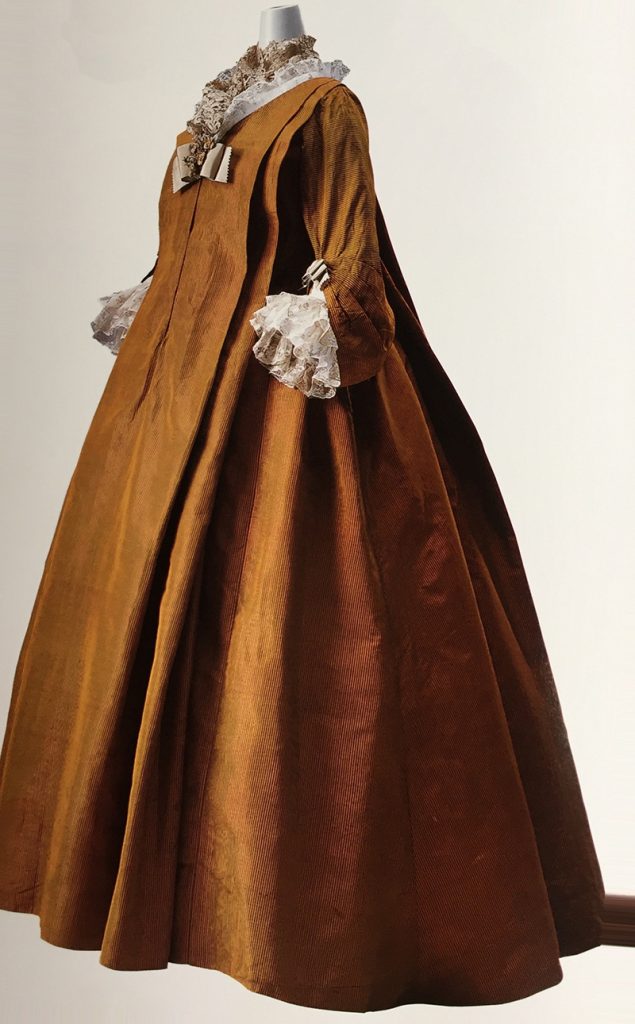
A new style of early eighteenth-century fashion was the robe volante, the flowing gown, derived from the négligée, which was worn during the latter years of the reign of Louis XIV. Volante means flounce in French, and since the large flounce, which flowed from the shoulders to the ground and was shaped to spread softly over the skirt, characterized this style of gown, it came to be called the robe volante. Although the corset was worn tightly laced underneath, the loose-fitting robe gave a comfortable and relaxed impression on the outside.

Lace, created with the most delicate hand techniques, was significant in embellishing wardrobes for both men and women. Needlepoint lace, based on embroidery techniques, and bobbin lace, based on braiding techniques, both developed in late-sixteenth century Europe. Lace production was prominent in parts of Italy, France, and Belgium, and these various types of lace were named after the areas in which they were produced. Shown on the left page, the quilles that stretch from the neck to the hem at the front opening of the robe, the lappets on the headdress, and the engageantes on the cuffs, all of which are lace, give the gown an even more luxurious look. Since lace was the most expensive kind of ornament to adorn a gown, the type of lace that made up the engageantes varied, from layers of high-quality lace to inexpensive cotton drawn work. The decorative lace apron was one of the most popular items in women’s wardrobes during the eighteenth century.

The robe a la française, a dress with a V-shaped opening in th efront, was worn with a stomacher, atriangular panel with a V- orU_shaped bottom, which covered the front of the bodice.A small inner pocker was sometimes attached to th estomacher. To keep th ebosom from standing out, the stomacher was extavagantly adorned with embroidery, laces, rows of neatly arranged ribbon bows called an echelle (ladder), and sometimes jewelry. Since stomachers needed to be pinned to the dress each time they were worn, this style was time-consuming to wear.

During this period, people longed for a more comfortable style. The informal bodices and skirts worn by common people influenced upper-class women’s costumes, which at the time were gradually shifting to a more simplified design. Practical short jackets, the casaquin and caraco, appeared in many forms and varieties, and each was given a different name. Such is the case with the jacket in the plate—this was specifically called a pet en l’air.
During the eighteenth century, mitts, or fingerless gloves, became popular. The most common type was one in which the thumb was separate from the other four fingers, and the back of the hand was covered with a triangular flap. The decorative mitts were worn up through the nineteenth century.

During the eighteenth century, the neckline of dresses was wide and Open, A triangular fichu was draped over the shoulders, loosely covering the open area, and was fastened on the stomacher. As shown on this dress, the style where both ends of the fichu cross through the stomacher band is similar to the fashion that appears in the painting Madame d’Epinay by Jean-Etienne Liotard.
References:
Fashion – A History from the 18th to the 20th Century, Volume 1: 18th and 19th Century